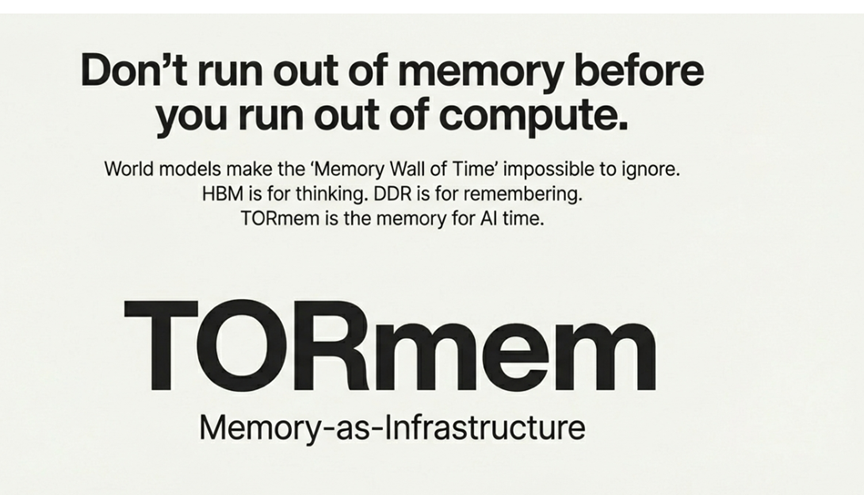
GPU Memory for World Models: HBM vs. DDR
Why World Models Break GPU Memory Limits — and Why Memory-as-Infrastructure Is the Next AI Category
Executive Summary
A new class of AI systems called world models processes time instead of tokens. These systems require persistent temporal memory far beyond GPU HBM capacity. This paper explains why world models break GPU memory limits and introduces Memory-as-Infrastructure for AI Time Context enabled by TORmem.
1. From Tokens to Time
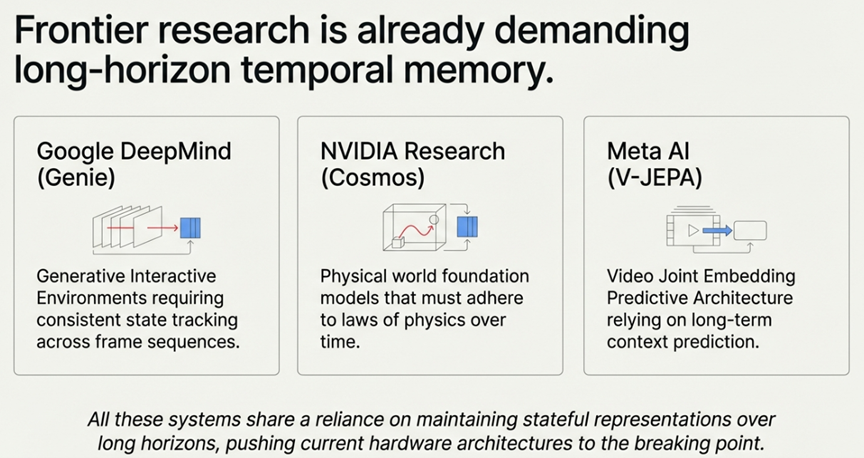
| AI Generation | Input | Context Type | Memory Behavior |
|---|---|---|---|
| LLMs | Words / tokens | Short conversational history | Fits in HBM / GPU memory |
| Vision Models | Images | Spatial context | Fits in GPU memory |
| World Models | Video, sensors, simulation time steps | Temporal context across minutes/hours | Explodes beyond GPU memory |
2. What Is a World Model?
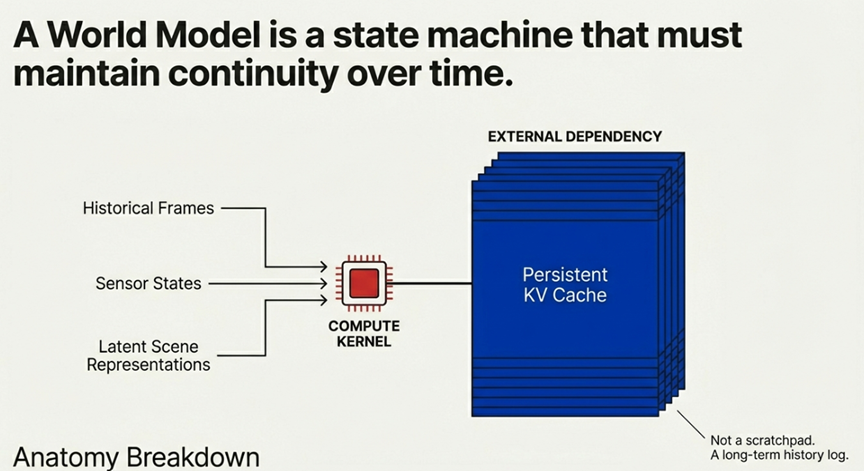
World models maintain stateful representations over time including historical frames, sensor states, latent scene representations, and persistent KV cache.
3. Evidence from Leading Research
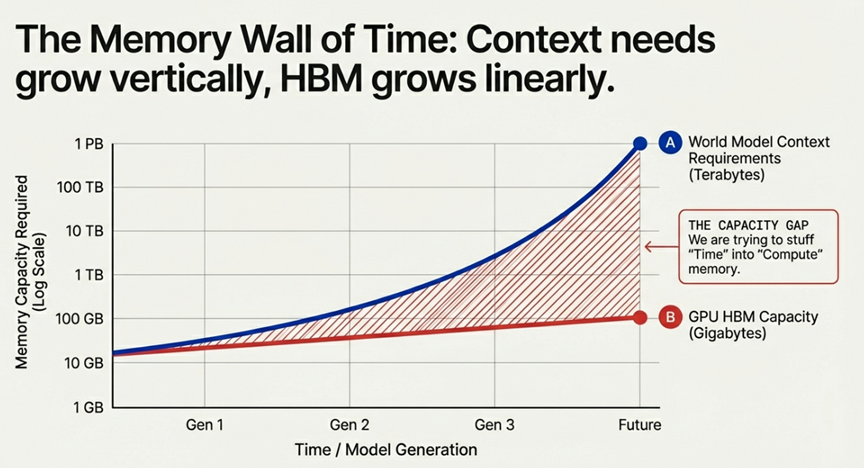
Examples from Google DeepMind (Genie), NVIDIA Research (Cosmos), and Meta AI (V-JEPA) show increasing reliance on temporal memory across long horizons.
4. Why GPU HBM Fails for World Models
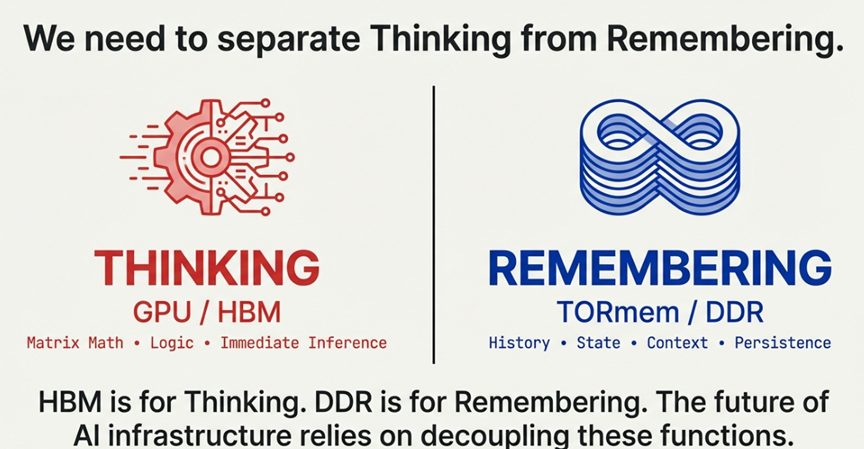
HBM is optimized for compute and short context. World models require terabytes of memory for persistent temporal context. HBM is for thinking. DDR is for remembering.
5. Reframing KV Cache as Persistent Temporal Memory
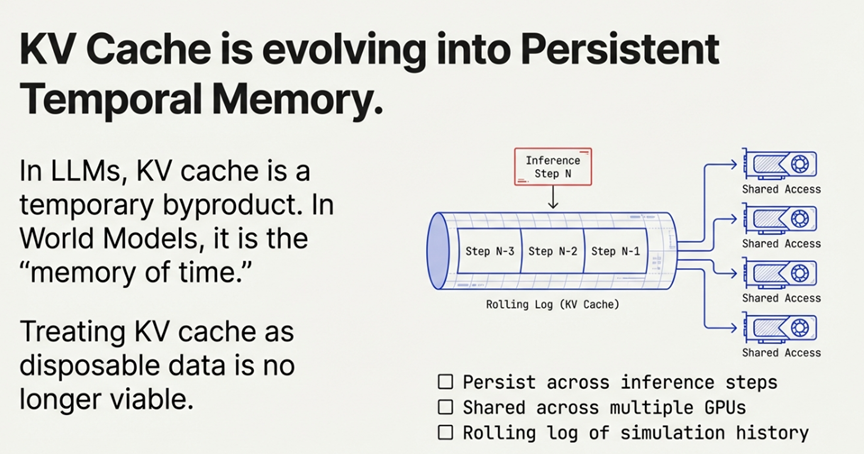
KV cache becomes a rolling memory of time that must persist across inference steps and be shared across GPUs.
6. The New Category: Memory-as-Infrastructure for AI Time Context
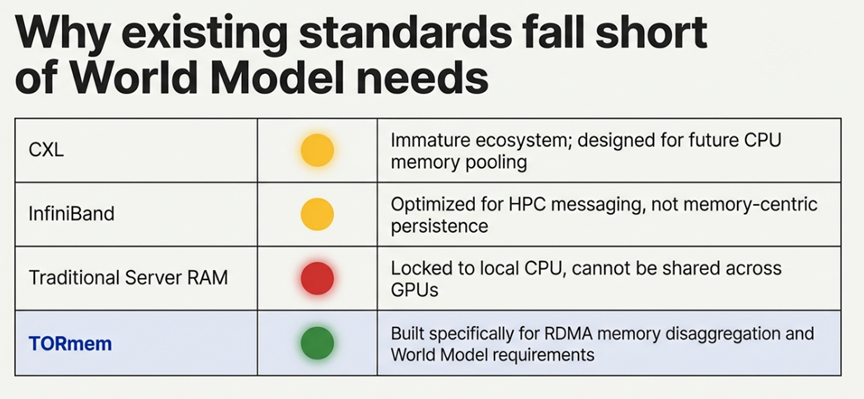
Solving this problem does not require larger GPUs. It requires a new infrastructure layer dedicated to remembering. A layer where:
- KV cache becomes persistent temporal memory
- Historical context can scale to terabytes
- Multiple GPUs can share the same time memory pool
- Memory grows with the model’s need to understand the past
7. Target Industries
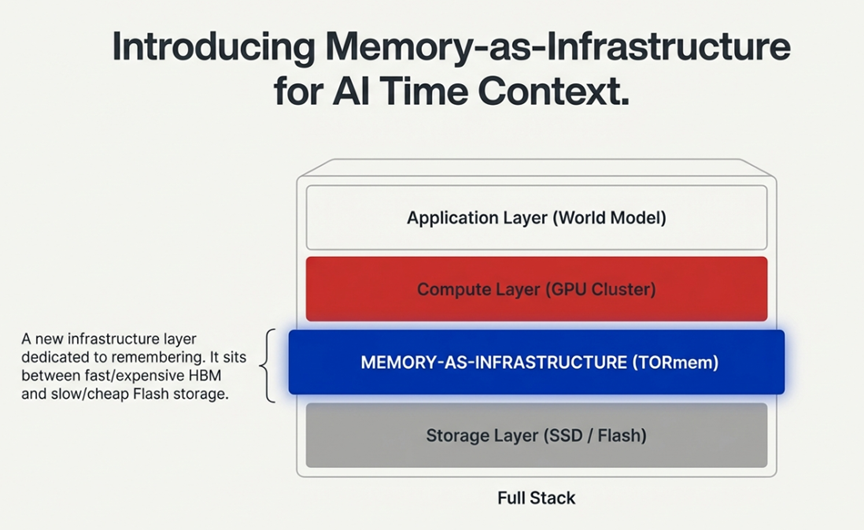
- Video AI Companies
- Robotics AI
- Simulation / Digital Twin
8. Why TORmem, Not CXL or InfiniBand
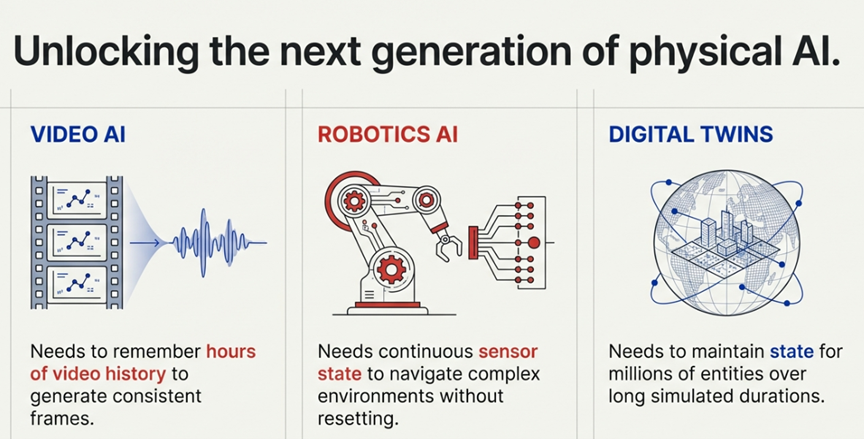
| Technology | Designed For | Limitation for World Models |
|---|---|---|
| CXL | Future CPU memory pooling | Immature ecosystem |
| InfiniBand | HPC messaging | Not memory-centric |
| Traditional servers | Local RAM | Not shareable across GPUs |
| TORmem | RDMA memory disaggregation | Built for world model memory needs |
The Memory Wall of Time
The next bottleneck in AI will not be compute, networking, or storage. It will be the ability of AI systems to remember what happened over time.
World models make this limitation impossible to ignore. These systems do not process tokens or images in isolation. They process continuous streams of time—video frames, sensor inputs, simulation steps, and environment states that must be retained to predict what happens next.
GPU memory was never designed for this. HBM is optimized for fast matrix computation and short-lived context. It is the perfect medium for thinking. But world models demand something entirely different: persistent temporal memory that grows with every frame, every step, every second.
This is why teams building video foundation models, robotics AI, and simulation platforms are beginning to encounter a new and unfamiliar constraint: They are running out of memory long before they run out of compute. This is the Memory Wall of Time.
Solving this problem does not require larger GPUs. It requires a new infrastructure layer dedicated to remembering. A layer where:
- KV cache becomes persistent temporal memory
- Historical context can scale to terabytes
- Multiple GPUs can share the same time memory pool
- Memory grows with the model’s need to understand the past
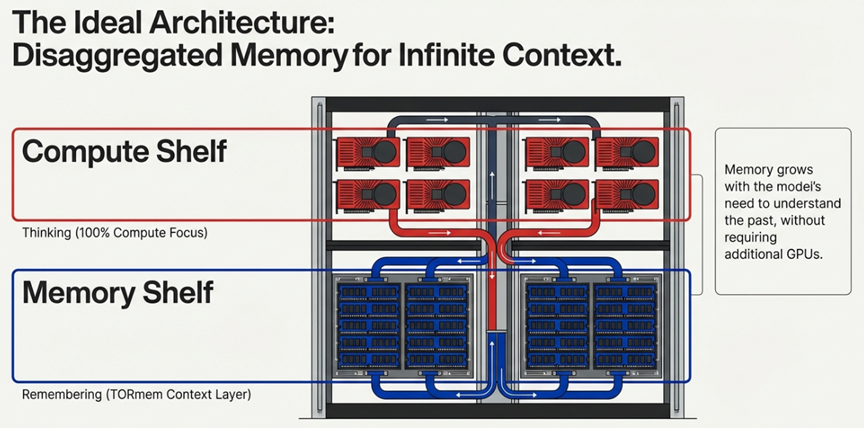
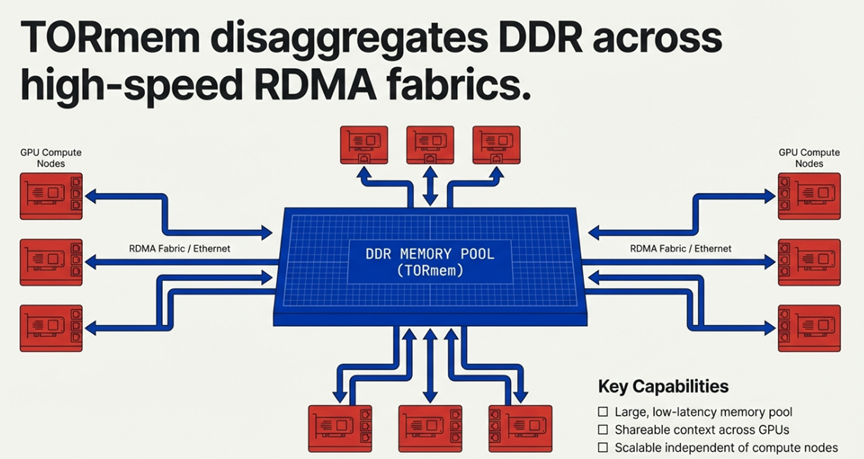
This is precisely the problem TORmem was built to solve. By disaggregating DDR memory across high-speed RDMA Ethernet fabrics, TORmem provides the large, low-latency memory pool required for AI systems that operate across time rather than tokens.
This defines a new category in AI infrastructure: Memory-as-Infrastructure for AI Time Context.
HBM is for thinking. DDR is for remembering. TORmem is the memory for AI time.